01 · GENERATIVE DIGITAL TWINS
Proactive Wireless Networks with Generative Digital Twins
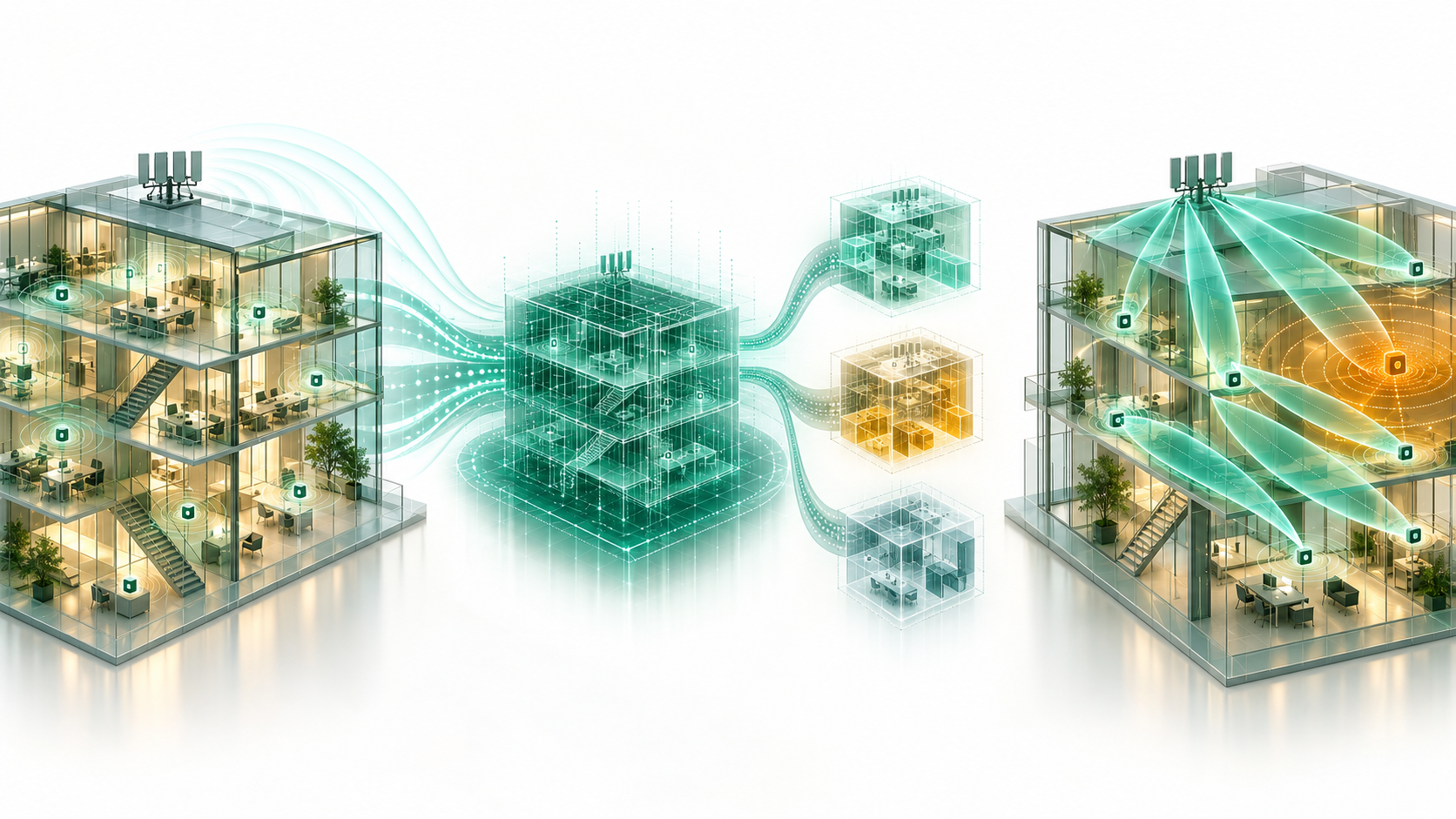
Anticipating interference before it disrupts connectivity: a site-specific Digital Twin and Generative AI explore plausible future channel and blockage conditions to guide proactive beamforming.
The challenge
Mobility and blockage can change wireless conditions before a network reacts. Extremely large antenna arrays add complexity as users experience both near-field and far-field propagation.
The approach
A Digital Twin models the deployment geometry. Generative AI uses this environment and historical network states to generate multiple plausible futures, helping configure beamforming ahead of changing interference conditions.
What the study shows
Sionna ray-tracing simulations in open and cluttered indoor environments show improved interference suppression, signal quality, and prediction accuracy compared with reactive and deterministic Digital Twin benchmarks.
Combining environmental awareness with multiple plausible futures can help wireless networks prepare for disruption.
Paper & Research Team
A Generative AI-Enhanced Digital Twin Framework for Proactive Interference Management in Hybrid Near/Far-Field Wireless Systems
Afan Ali · Ali Arshad Nasir · Daniel Benevides da Costa
IRC-CSS and Department of Electrical Engineering, KFUPM